Writing: Simple Sentences درس اول زبان انگلیسی یازدهم
**Simple Sentences**
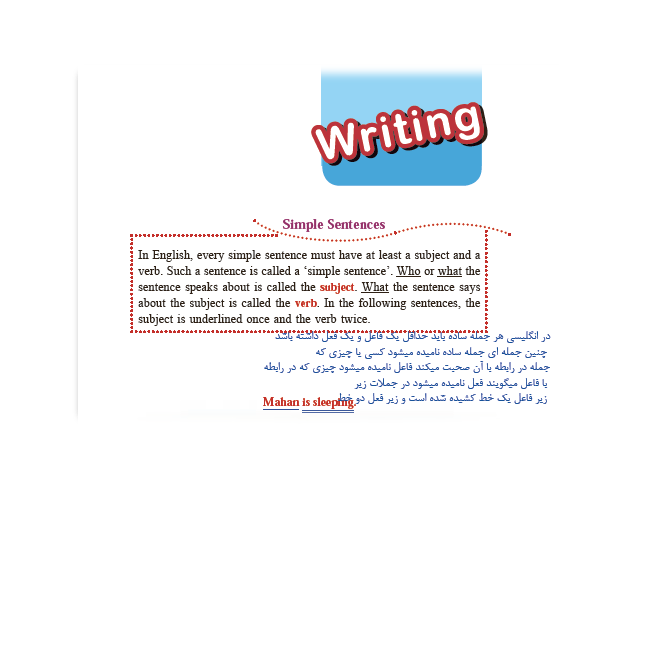
In English, every simple sentence must have at least a subject and a verb. Such a sentence is called a 'simple sentence'. Who or what the sentence speaks about is called the subject. What the sentence says about the subject is called the verb.
**Examples:**
$\underline{\text{Mahan}}$ $\underline{\underline{\text{is sleeping}}}$.
The $\underline{\text{bird}}$ $\underline{\underline{\text{does not sing}}}$.
The $\underline{\text{apple}}$ $\underline{\underline{\text{fell down}}}$.
The $\underline{\text{teacher}}$ $\underline{\underline{\text{is hard-working}}}$.
**Hint:** A sentence begins with a capital letter and ends with a period.
**Parts of a Simple Sentence**
An object is a noun that receives an action.
**Examples:**
The $\underline{\text{students}}$ $\underline{\underline{\text{are drinking}}}$ $\mathbf{milk}$.
$\underline{ ext{The students}}$ $\underline{\underline{\text{learn}}}$ $\mathbf{English}$.
$\underline{\text{Mahdi}}$ $\underline{\underline{\text{visited}}}$ his $\mathbf{doctor}$.
**Hint:** A simple sentence can also have additional information mostly in the forms of 'adverbs of place, time and manner'.
**Examples:**
$\underline{\text{Ali}}$ $\underline{\underline{\text{will have}}}$ an $\mathbf{exam}$ $\mathbf{next}$ $\mathbf{week}$ (Time).
$\underline{\text{Zahra}}$ $\underline{\underline{\text{studies}}}$ $\mathbf{English}$ $\mathbf{at}$ $\mathbf{school}$ (Place).
$\underline{\text{We}}$ $\underline{\underline{\text{usually visit}}}$ $\mathbf{our}$ $\mathbf{grandmother}$ $\mathbf{on}$ $\mathbf{Fridays}$ (Time).
پاسخ گام به گام و تشریحی Writing: Simple Sentences درس اول زبان انگلیسی یازدهم
این بخش به توضیح ساختار اساسی جمله ساده ($\text{Simple Sentence}$) در زبان انگلیسی میپردازد.
**1. تعریف جمله ساده ($\text{Simple Sentence}$):
* هر جمله ساده حداقل باید شامل یک **فاعل ($\text{Subject}$)** و یک **فعل ($\text{Verb}$)** باشد.
* **فاعل:** کسی یا چیزی است که جمله در مورد آن صحبت میکند. (چه کسی؟ یا چه چیزی؟)
* **فعل:** عملی است که فاعل انجام میدهد، یا حالتی است که فاعل در آن قرار دارد. (چه کاری انجام میدهد؟)
* **قاعده گرامری پایه:** $\mathbf{Subject}$ $\mathbf{+}$ $\mathbf{Verb}$
**2. فاعل ($\text{Subject}$):
* فاعل همیشه یک **اسم** ($\text{Noun}$) یا یک **ضمیر** ($\text{Pronoun}$ - مانند $\text{I, we, he, she, it, you, they}$) است.
* **مثال:** $\underline{\text{Mahan}}$ $\text{is sleeping.}$ $\to$ $\text{Mahan}$ کیست؟ فاعل است.
**3. مفعول ($\text{Object}$):
* مفعول یک اسم است که **عمل فعل را دریافت میکند**.
* برای یافتن مفعول، بپرسید: «فاعل چه کسی/چه چیزی را [فعل] میکند؟»
* **قاعده گرامری با مفعول:** $\mathbf{Subject}$ $\mathbf{+}$ $\mathbf{Verb}$ $\mathbf{+}$ $\mathbf{Object}$
* **مثال:** $\text{The students learn}$ $\mathbf{English}$. $ o$ دانشآموزان **چه چیزی** را یاد میگیرند؟ $\mathbf{English}$ (مفعول است).
**4. اطلاعات تکمیلی ($\text{Additional Information - AI}$):
* جمله ساده میتواند اطلاعات اضافی (اغلب به شکل **قیود مکان، زمان و حالت**) داشته باشد.
* **مثال:** $\text{Zahra studies English}$ $\mathbf{at}$ $\mathbf{school}$ ($\mathbf{AI}$ $\mathbf{Place}$). (زهرا انگلیسی را در مدرسه میخواند.)
* **مثال:** $\text{Ali will have an exam}$ $\mathbf{next}$ $\mathbf{week}$ ($\mathbf{AI}$ $\mathbf{Time}$). (علی هفته آینده امتحان دارد.)